Buying stock fabric in Guangzhou Zhongda can dramatically shorten product development timelines. For sampling, limited collections, and early-stage brands, it is often the most practical sourcing strategy. However, once a brand begins planning repeat production and long-term growth, the same approach can introduce risks that are difficult to detect until bulk production has already started.
This guide explains how Guangzhou’s textile markets actually operate from an experienced buyer’s perspective, when stock fabrics remain the right choice, and why many successful brands use both stock fabrics and custom-milled fabrics strategically to secure material consistency.
1. A Sourcing Lesson from the Cutting Room: The Reality of Fabric Stability
One lesson we’ve learned repeatedly on production floors is simple: if the physical stability of the fabric is structurally flawed, no level of tailoring craftsmanship can save the garment.
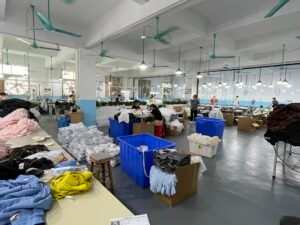
We still remember a production supervisor calling us a few hours before cutting started on a heavyweight fleece apparel run.
“This isn’t the same fabric,” he explained over the phone. “The fabric showed severe grain distortion during spreading. The moment we lay it on the table, it skews. The seamstresses won’t be able to hold a straight line.”
This was the direct outcome of a project where an overseas client, facing a tight cost-per-garment target, requested us to bypass the primary showrooms in the main building and source an alternative across the street in Changjiang Textile City (长江中国轻纺城).
During the initial sampling stage, the stock fabric from Changjiang felt adequate. But once thousands of meters hit the actual production line, the reality set in. During fabric relaxation, spreading, steam pressing, and sewing, the residual knitting tension gradually released, causing severe skew distortion. During sewing, the side seams of the hoodies twisted. If the fabric grain is already skewed before cutting, any subsequent manufacturing steps become ineffective. Once washed, the side seams will inevitably shift.
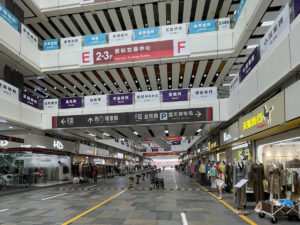
2. Navigating the Real Structure of Guangzhou International Textile City
One common misconception among overseas buyers is treating the Zhongda fabric market (中大面料市场) as a singular wholesale entity with a uniform quality standard. In reality, it is a highly fragmented ecosystem.
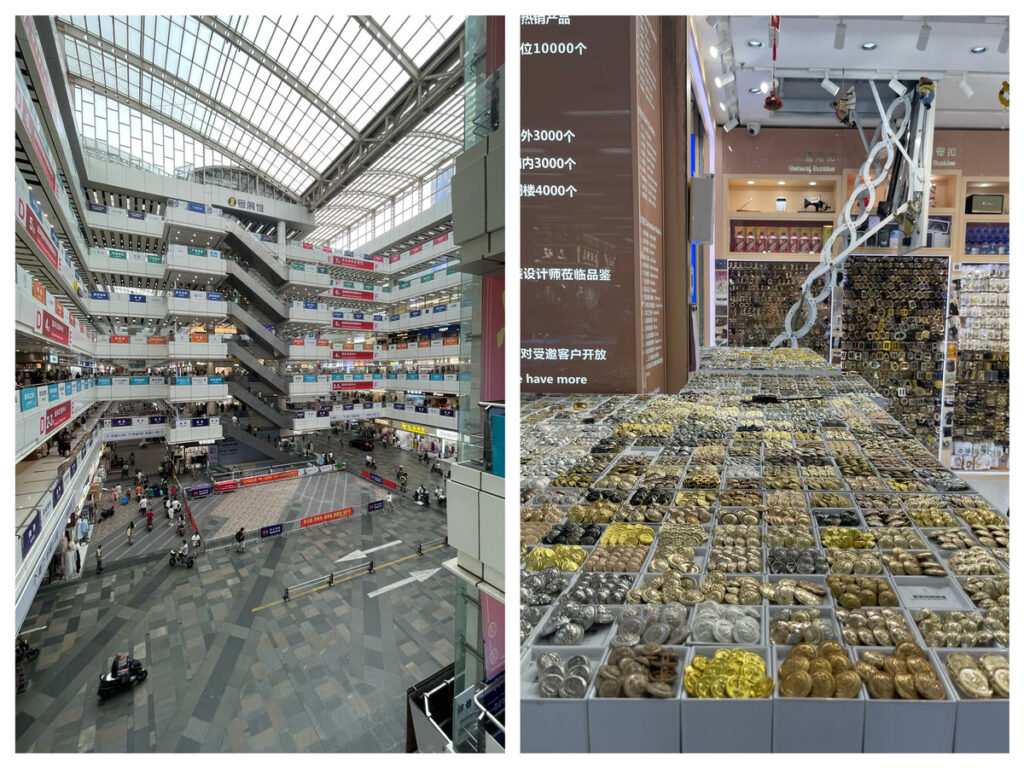
First Floor (1F): Factory Showrooms, Traders, and Agents
The ground floor of Guangzhou International Textile City (广州国际轻纺城) represents premier textile manufacturers, but also includes general agents, trading companies, and brand stalls. These showrooms offer high quality consistency but operate with rigid minimum order quantities (MOQs).
One thing surprises many overseas visitors here: suppliers on the first floor are often less interested in small orders than those upstairs. We’ve seen showroom staff simply point to the “300kg Minimum” sign before even introducing the technical details of the fabric itself.
- Zones A & B (Core Knits): The primary destination for premium T-shirt and hoodie cottons. If you are handling heavyweight French Terry sourcing, this is where highly stable mills reside.
- Zones C & D (Patterned & Jacquard Knits): For multi-colored stripes and custom jacquards. Showrooms like Taisen (泰森), Jufeng (巨丰), and Dongsheng (东盛) are located here. Their pricing sits at the top of the market average, but their yarn quality is reliable.
- Zones E & F (Wovens & Technical Synthetics): This area houses high-performance circular knits optimized for yoga wear and swimwear, along with organic linen clustered around the 3rd Street stalls.
Second and Third Floors (2F-3F): Material Development
The upper floors are where independent designers and growing brands often go to develop proprietary materials. Showroom representatives here are highly communicative and offer flexible cutting minimums.
- Engineered Linen Blends: Stalls here offer linen blended with viscose or tencel. While not entirely “wrinkle-resistant,” these blends achieve an elegant drape and offer significantly better wrinkle recovery than pure linen.
- Texture and Performance: This is the go-to zone for sourcing slub and nep effects for vintage aesthetics, as well as technical coatings like Teflon DWR for tactical outerwear.
Basement B1: Trims, Webbing, and Hardware
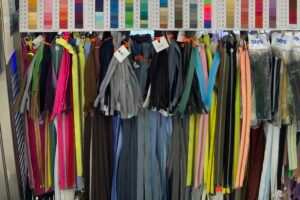
Near the central escalator exits, specialized webbing and drawcord suppliers offer heavy-cotton cords and custom-weave elastics. Further inside, the floor hosts suppliers of high-grade polyester lace, water-soluble lace, and complex 3D hand-sewn embellishments.
3. Beyond the Main Building: Peripheral Specialized Hubs
To achieve comprehensive material control, an experienced buyer must map the surrounding streets.
Changjiang Textile City (长江轻纺城)
Located directly across the main road, this market is primarily a massive clearinghouse for stock fabrics. It is inaccurate to state that Changjiang is entirely “low quality.” In reality, it contains a vast mix of fabrics: mills from Guangdong, Zhejiang, Fujian, and Jiangsu, alongside factory overstock and export cancellations.
Because of this diverse sourcing pool, quality consistency varies significantly. It primarily feeds China’s high-turnover domestic fast-fashion hubs. While it is an excellent market for sourcing athletic mesh netting and spacer fabrics along the exterior roadside shops, buyers must understand that long-term replenishment can be highly unstable here.
Specialized Authority Buildings
- Ruikang Building (瑞康大厦): The dedicated source for industrial lace, tulles, and specialized netting.
- Wufeng West Denim Market (五凤西场): The regional authority for raw denim from 12 oz to 16 oz, essential for executing high-end stone-washing.
- Qingfang 2nd Street & Wufeng East (五凤东场): The specialized cluster for genuine leathers and technical PU synthetic materials.
4. The Structural Risks of Available Stock Fabric Lots
Stock fabrics are not inherently low quality. The primary challenge lies in long-term consistency, availability, and repeatability. When a brand expands, relying purely on stock rolls introduces specific operational variables:
- The Availability Trap: Most stock fabrics sold in Guangzhou are excess runs from large factory productions. If an ad campaign goes viral, you may return to the stall only to find the specific roll is permanently out of production.
- Dye Lot Variation (缸差): When replenishing stock fabric, you may receive Roll A the first time, and Roll B the second time. This isn’t intentional deception; the supplier simply sold out of the previous batch. One supplier assured us that a new batch would be identical. When we compared both rolls under a D65 light box, the shade difference was immediately visible.
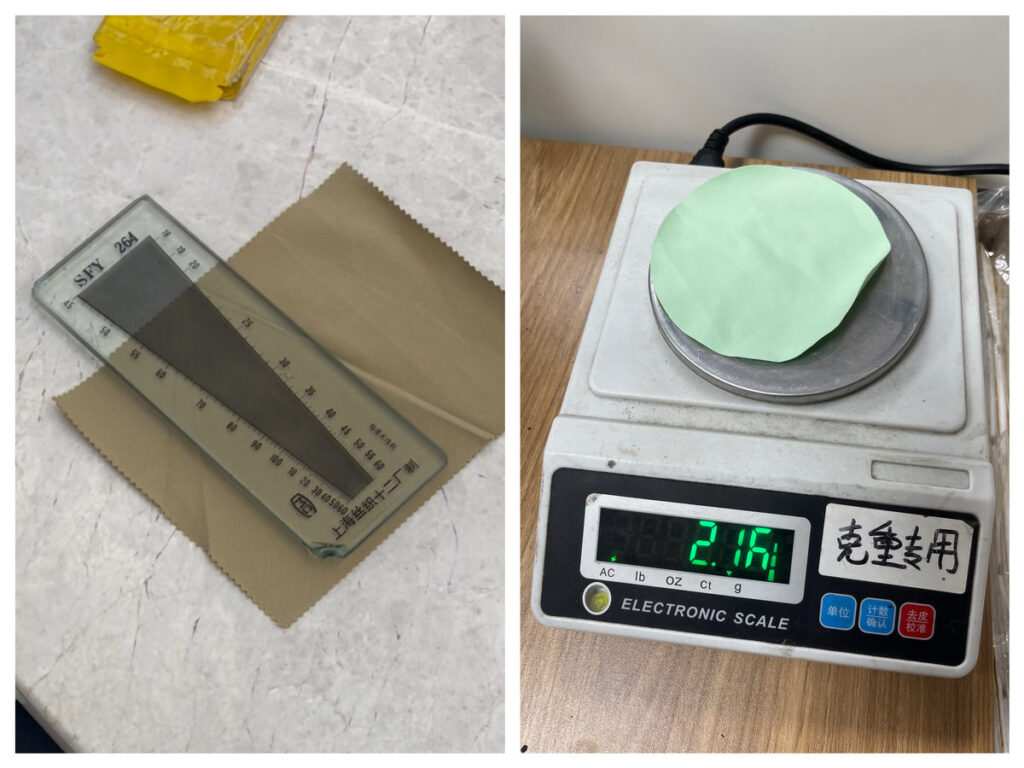
- Lack of Pre-Shrinking: To minimize processing costs, stock knit rolls frequently omit critical finishing steps like compacting, relaxation, or heat setting. An untreated heavyweight cotton knit can easily experience 5% to 8% shrinkage after its first domestic wash.
- GSM Drift: Stock stacks are often mixed lots. After opening a third roll of supposed 400 GSM fleece, our QC team found the GSM had already drifted by nearly 18 grams. Variations of 10–20 GSM are not uncommon between batches, which can subtly alter the drape of an oversized silhouette.
5. Sourcing Strategy Matrix: When to Stay with Stock
Recognizing when to transition between stock materials and custom fabric manufacturing is one of the most critical decisions an apparel entrepreneur will make.
SHOULD YOU BUY STOCK FABRIC?
If your current production run is:
- Developing initial samples
- First experimental collection
- Limited capsule drops (<100 pcs)
Your Optimal Sourcing Action:
Leverage flexible cutting rolls to maximize your upfront capital liquidity and test market speed.
If your current production run is:
- Evergreen core products
- Continuous replenishment runs
- Wholesale and retail distribution
Your Optimal Sourcing Action:
Lock in your proprietary formulas for consistent weight & dye lots.
The Balanced Sourcing View
Many successful brands use both stock fabrics and custom-milled fabrics strategically. They utilize custom-milled and dyed fabrics for their core, repeatable collections to guarantee absolute quality continuity, while leveraging Guangzhou’s advanced post-processing stock fabrics for limited-edition, trend-driven drops where speed to market is critical.
6. The Six Technical Checkpoints of a Professional Sourcing Partner
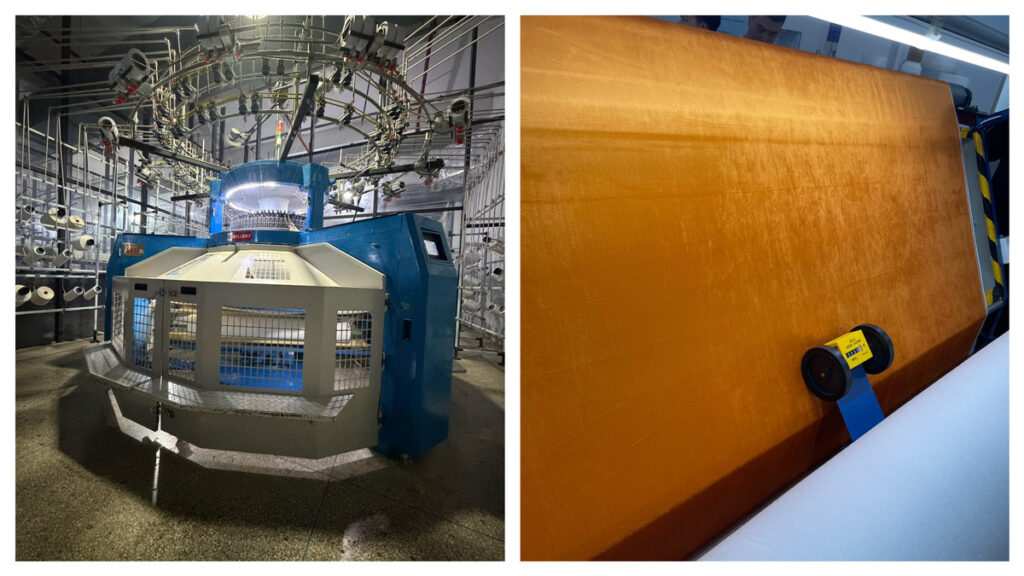
Managing a fabric supply chain from Guangzhou requires physical infrastructure on the factory floor. At V7proX, we protect your brand equity using six verifiable inspection checkpoints before a single marker is printed:
- Fabric Relaxation (放布): Knit fabrics must undergo a relaxation process for 12–24 hours before cutting. Bypassing this step guarantees dimensional instability in the finished garment.
- Spreading Direction (铺布方向): If a fabric batch is cut mixing nap directions (顺逆毛混裁), the finished garment will display severe panel shading. We audit the spreading direction of every layer.
- Fabric Inspection (Four-Point System): We do not rely solely on hand-feel. We run bulk rolls through motorized inspection tables utilizing the international Four-Point System to grade knitting defects. We often ask to inspect rolls under natural daylight instead of warm showroom lighting to reveal hidden flaws.
- Lab Dip & Bulk Shade Approval: Professional brands do not approve production based merely on A4 color swatches. We manage the Lab Dip process and require sign-off on the actual Bulk Shade sample before full dyeing begins.
- Roll-to-Roll Shade Variation: Even within an approved dye lot, slight variances occur. We perform shade grouping across all delivered rolls to ensure panels from mismatched rolls are never sewn together.
- Marker Efficiency: The cuttable width of stock rolls can fluctuate. This variance directly impacts digital marker efficiency, which directly dictates your fabric utilization rate and unit cost.
7. Sourcing Technical Matrix: Stock vs. Custom-Milled
To help your production team evaluate supply chain resilience, we have structured the operational variables below:
| Sourcing Metrics | Stock Fabric (Zhongda Stalls) | Custom-Milled Fabric (Direct Mills) |
|---|---|---|
| Minimum Order Quantity (MOQ) | Highly flexible (1 meter to 1 roll) | Typically 300+ kg depending on the mill and fabric type. |
| Color Match Consistency | Variable (Subject to dye lot availability) | High (Locked via Lab Dips & Bulk Shade approval) |
| Shrinkage Control | Unpredictable (Drifts between 5% – 8%) | Guaranteed (Pre-shrunk / Compacted) |
| Supply Continuity | Unstable (High risk of sudden stockout) | Permanent (Production parameters can be reproduced) |
| Development Lead Time | Immediate (Same-day local delivery) | 15 – 25 days (Requires full knitting and finishing cycles) |
8. Transitioning Your Fabric Sourcing in Guangzhou
Brands that scale successfully usually establish strict supplier verification procedures before moving into heavy replenishment runs. If your team is evaluating mills in Guangzhou, we’re happy to accompany factory visits, review fabric specifications, or help compare suppliers before production begins.
FAQs: Sourcing Fabric in Guangzhou Zhongda
For standard circular knits like French Terry or single jersey, custom dyed fabric China mills generally require a minimum of 300+ kg depending on the mill and fabric type. This volume allows the dye house to fill a dyeing vat efficiently, avoiding auxiliary lesser vat fees.
Pure flax fibers possess rigid molecular structures with low elastic recovery. The advanced linen-viscose or linen-tencel blends engineered by suppliers on the 2nd and 3rd floors introduce highly flexible regenerated cellulose fibers, achieving a smooth drape and significantly better wrinkle recovery.
Never authorize bulk cutting based on verbal confirmations. Instruct your fabric supplier Guangzhou agent to cut a 1-meter “Pre-Shipping Sample” directly from the exact rolls allocated for your order. Evaluate this sample inside a standard light box under D65 and TL84 light sources to physically verify the color drift against your previous garments.